Most people shopping for a concrete contractor are comparing three numbers on three pieces of paper and picking the middle one. That's not enough here. Gaithersburg sits in the Piedmont, where the ground under a lot can be heavy clay in one yard and sitting right on schist bedrock two doors down. A driveway or patio that holds up on one street can crack within two winters on the next, and the difference usually isn't the concrete. It's what's underneath it, and whether the contractor prepped for it.
Start with what's under your lot
Montgomery County clay soil expands when it's wet and shrinks when it dries out. That movement is what pushes slabs out of level and opens hairline cracks at the edges of driveways and steps. A contractor who knows the area will compact a gravel sub-base, usually 4 to 6 inches, before any concrete goes down, and will grade it so water doesn't pool against the house. If someone quotes you a price without ever mentioning base prep, ask what's actually happening before the pour. The slab is the easy part. The dirt is where most failures start.
Older streets around Olde Towne Gaithersburg were built mid-century, and the soil there has had decades to settle around original foundations, utility lines, and sewer laterals that aren't always where the county map says. Newer subdivisions like Kentlands and Lakelands sit on what used to be farmland, regraded and filled in the 1990s. Fill soil compacts unevenly if it wasn't done right the first time, so a new driveway there can still settle unevenly if the contractor skips proper compaction and just pours on top of what's already there.
Ask what's actually in the mix
Not all concrete is the same strength. Sidewalks and patios are typically fine at 3,000 to 3,500 psi. Driveways, garage slabs, and anything that'll see a car regularly should be 4,000 psi, and in this climate it should be air-entrained, meaning tiny air bubbles are mixed in to give water somewhere to go when it freezes. Gaithersburg gets routine freeze-thaw cycles from November through March, and plain concrete without air entrainment will spall and flake at the surface within a few winters, especially where road salt or deicer gets tracked onto it. A contractor who can tell you the psi and whether it's air-entrained without checking a chart has poured a lot of driveways. One who shrugs and says 'it's just concrete' hasn't thought about your winters.
For reinforcement, ask whether they're using rebar or wire mesh, and where it sits in the slab. Mesh that ends up sitting on the gravel instead of suspended mid-slab does nothing. Rebar on a 12 to 18 inch grid is standard for driveways and garage slabs carrying vehicle weight. A good crew will tell you this unprompted, because it's one of the first things that fails if it's skipped.
Timing matters more here than people think
Concrete needs to stay above roughly 50 degrees while it cures, and Gaithersburg's shoulder seasons, late fall and early spring, can swing 30 degrees in a single day. A contractor pouring in that window should know to use insulated blankets or an accelerator in the mix, not just pour and hope. Summer is its own problem. A slab poured on a 95 degree July afternoon can skin over on top before it's cured underneath, which leads to surface cracking called crazing. Experienced crews pour early in the morning in summer and mist the surface as it cures. If a contractor wants to pour at 2pm on the hottest day of the week because that's when their schedule has an opening, that's worth questioning.
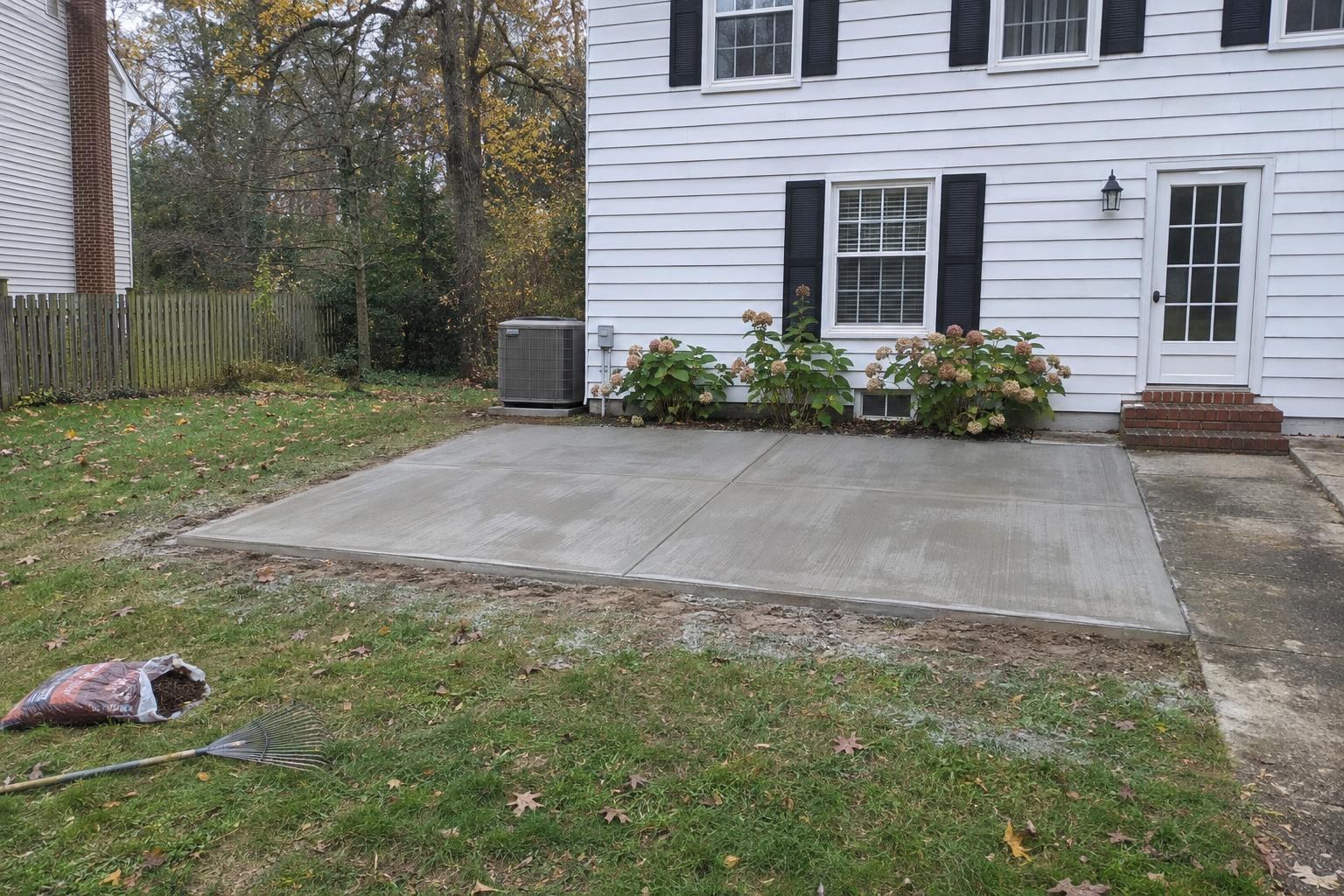
Control joints, the straight cuts you see dividing a driveway into sections, need to go in within 24 to 48 hours of the pour, before the slab decides on its own where it wants to crack. A joint cut a quarter of the slab's depth gives the concrete a weak point to crack at cleanly, hidden in the joint line instead of running diagonally across your new patio. Ask how soon after the pour they'll be back to cut joints. If the answer is vague, that's a sign they're not thinking about it as part of the job.
Permits, inspections, and HOAs
Montgomery County's Department of Permitting Services generally gets involved when work changes drainage, touches the public right-of-way, or is structural, like a new foundation or a footing for steps. A straightforward patio replacement in your own backyard might not need a permit at all, but a new driveway apron that connects to the street usually does, and the county will check the base prep before the pour and the finished grading after. A contractor who's worked in the county will know which of your jobs needs a permit and which doesn't, and won't need you to figure that out for them.
If you're in a community with an HOA, and plenty of Gaithersburg neighborhoods like Kentlands or Quince Orchard are, stamped concrete color and pattern, and sometimes pool deck finishes, often need architectural approval before work starts. A contractor who's done work in your neighborhood before may already know what the HOA will and won't sign off on, which saves you a redo.
What to walk away from
- No proof of license or insurance. Ask for it directly and expect it on the spot, not 'I'll email it later.'
- A quote with one number and no mention of slab thickness, psi, or rebar versus mesh.
- Pressure to pay the full amount before any work starts. A deposit is normal. All of it upfront is not.
- Someone who wants to skip the permit to save time, even on work that clearly needs one. That decision becomes your problem at resale, not theirs.
- A bid that's dramatically lower than the others with no explanation. Usually it means thinner concrete, no rebar, or a sub-base that's just whatever dirt was already there.
A fair bid should walk you through the sub-base, the thickness, the mix strength, and roughly how many days before you can drive on it, usually 7 days for light traffic and closer to 28 for full strength. If a contractor can answer those questions without hesitating, they've done this enough times to know where things go wrong.
We've poured driveways, patios, and slabs across Gaithersburg and the surrounding towns long enough to know which streets have clay that holds water and which ones sit near rock. If you want a straight answer on what your lot actually needs, Foundation Concrete Company is a good place to start that conversation.